Why Glendora Homeowners Choose FAAC Gate Repair
Apex Gate Repair Services Glendora is an independent FAAC service provider — not factory-authorized, but 23 years deep in FAAC diagnostics, parts sourcing, and hands-on repair across the San Gabriel Valley. We service and install FAAC residential and commercial gate operators, control boards, and accessories for Glendora homeowners and property managers who need a technician who actually knows the product. Call (562) 378-6866 for a free estimate.
FAAC is an Italian-engineered brand with a strong foothold in the higher-end residential and light-commercial gate market — and its operators are genuinely well-built. But well-built doesn’t mean maintenance-free, and FAAC’s proprietary electronics, hydraulic components, and encoder-based logic boards require someone who has seen these systems fail, not someone learning them on your gate. That’s the difference we bring to every call in Glendora.
Why Trust Apex Gate Repair Services Glendora for Your FAAC Gate Repair?
Jonathan Wright — owner of Apex Gate Repair Services Glendora and the technician who shows up at your gate — has been diagnosing FAAC operators in the field for over two decades. When Jonathan arrives, you’re not getting a dispatched sub who pulled up the service manual on the way over. You’re getting someone who has pulled apart FAAC 400 series hydraulic units, traced voltage faults on FAAC E024S control boards, and sourced OEM-compatible capacitors and limit switch assemblies because the correct part is what makes the repair last.
We work exclusively in the gate trade. 23 years, one trade. That means our FAAC knowledge isn’t diluted by fencing, garage doors, or landscaping — it’s concentrated entirely on gate systems, which is why our diagnosis tends to land on the actual problem rather than the most obvious guess. Our 514 verified customer reviews averaging 4.9 stars reflect that consistency — neighbors in Glendora talk, and that’s where most of our calls originate. We stock OEM-compatible FAAC parts for common repair scenarios, keeping turnaround tight without compromising on part quality.
What happens when you call
- 1
A real person answersNo phone trees — you reach a local pro.
- 2
You get an upfront price rangeHonest numbers before anyone is dispatched.
- 3
A background-checked tech heads outLicensed & insured, dispatched right away.
- 4
You approve before work beginsNothing starts until you say go.
Common FAAC Gate Repair Problems We Fix in Glendora
- FAAC 400 / 402 / 422 Hydraulic Fluid Loss and Slow-Cycle Faults
The FAAC 400-series underground hydraulic operators are common on custom estate gates in north Glendora’s hillside neighborhoods. Over time — especially in Glendora’s summer heat that routinely exceeds 100°F — the hydraulic fluid degrades and internal seals soften, causing slow or incomplete arm travel. The gate might open halfway and stop, or fail to hold position on a sloped driveway. This is not a control board issue; it’s a fluid and seal service, and misdiagnosing it wastes time and money. - FAAC 844 / 846 Control Board Fault Codes and Lock-Out Conditions
The 844 and 846 control boards use a flashing LED sequence to indicate fault states — overload, obstacle detection, encoder error. On Glendora properties near the foothill corridor, Santa Ana wind events routinely knock gates into obstacle-fault mode mid-season, sometimes triggering board-level protection resets that a homeowner can’t clear through the standard user procedure. We read these codes, identify whether the board is genuinely damaged or just in a latched fault state, and resolve it without unnecessary board replacement. - FAAC Encoder and Limit Setting Drift
FAAC swing-gate operators use encoder-based positioning, which means travel limits are stored electronically rather than set by a physical stop. On sloped lots in the Glendora Highlands and hillside streets off Glendora Mountain Road, post settling and subtle grade changes shift the gate’s rest position enough that the operator “sees” the gate as having traveled past its stored limit — causing reversals, fault conditions, or a gate that stops two feet short of fully open. Reprogramming limits takes the right interface; it’s not a generic reset. - FAAC D600 / D700 Sliding Gate Motor Overload
FAAC’s rack-driven sliding gate motors are solid performers, but the D600 and D700 units are sensitive to track debris and rack-tooth wear. In Glendora, fall debris from mature oaks and liquid ambers along track channels accelerates tooth-skip and triggers thermal overload shutdowns. We clear, realign, and re-lubricate track systems and test motor amp draw against FAAC’s published threshold to confirm the operator is within spec before we leave. - FAAC Intercom and Access Control Integration Failures
Many Glendora properties pair FAAC operators with third-party keypads, intercoms, or vehicle loop detectors wired into the FAAC control board’s auxiliary inputs. When access control adds or replaces components, the auxiliary input logic can conflict with the board’s programmed timing — causing random openings, failure to close, or unresponsive remotes. We trace these integration faults at the board level rather than swapping components until something clears.
FAAC Parts & Our Repair-vs-Replace Approach
FAAC manufactures its own proprietary components — control boards, hydraulic actuators, encoder assemblies — and genuine OEM parts are the right call when the component is still in production and the repair timeline permits sourcing. For FAAC boards and hydraulic assemblies, OEM is usually worth the cost because the tolerances are specific and aftermarket alternatives for FAAC are thinner on the ground than they are for higher-volume North American brands.
That said, some components — capacitors, limit switches, relay modules — have quality aftermarket equivalents that perform identically in service. We’ll tell you which is which and why, so you’re not paying OEM prices for a part where it doesn’t matter.
On the repair-versus-replace question: if a FAAC operator is more than 15 years old, has hydraulic seal failure, and the board shows additional faults, replacement often pencils out better than stacking repairs on an aging unit. We’ll give you a straight read on that. If the gate is mechanically sound and one component has failed, we repair it. Call (562) 378-6866 and we’ll walk you through the numbers before any work begins.
Our FAAC Service Process — Step by Step
- 1
Diagnosis — Jonathan begins every FAAC service call by reading the control board’s fault history, checking motor amp draw, and inspecting mechanical components before touching any settings. On FAAC hydraulic units, we check fluid level and pressure behavior. On encoder-based operators, we verify stored limit positions against actual gate travel. We find the root cause before recommending a repair path.
- 2
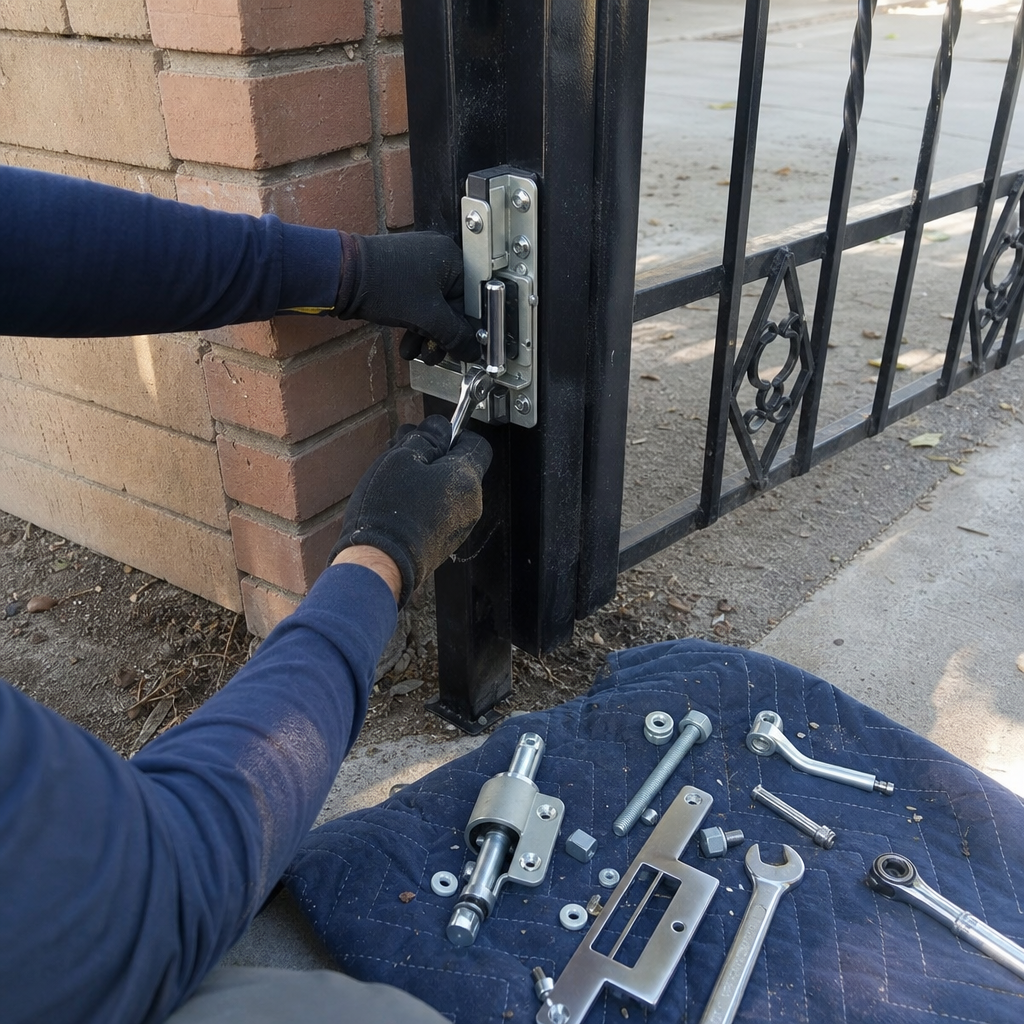
Repair or Installation — We carry OEM-compatible FAAC parts for common failures on residential calls in Glendora, which means we can often complete the repair in a single visit. For hydraulic seal kits, specific control boards, or less common FAAC model parts, we source promptly and schedule a follow-up rather than leaving the gate disabled.
- 3
System Test — After repair, we cycle the gate through its full travel sequence, verify obstacle-detection sensitivity, test all remote and access control inputs, and confirm the board is logging no active faults. On FAAC swing operators, we confirm hydraulic arm pressure is consistent across both leaves if it’s a dual-gate setup.
- 4
Walk-Through — We show you what failed, what we did, and what to watch for — including any maintenance steps specific to your FAAC model that will extend the repair. You should understand your own gate.
FAAC Products We Service & Install in Glendora
We service and install FAAC’s residential and light-commercial product lines, including:
- FAAC 400 / 402 / 422 series — underground hydraulic swing-gate operators
- FAAC 390 / 391 series — surface-mount electromechanical swing operators
- FAAC 770 / 740 series — heavy-duty swing operators for large or heavy leaf gates
- FAAC D600 / D700 series — rack-driven sliding gate operators
- FAAC 844 / 846 / 790 control boards — board repair, replacement, and reprogramming
- FAAC receiver and transmitter systems — remote programming and replacement
- FAAC safety edges, photocells, and loop detectors — safety device integration and testing
If your FAAC model isn’t listed, call us anyway — 23 years in the trade means we’ve encountered models well outside the current catalog.
We Also Service These Brands
FAAC is one of nine gate-operator brands we’re certified to work on. If your property has a mix of operators, or you’re comparing brands for a new installation, we service LiftMaster, BFT, Linear, and Viking systems with the same depth we bring to FAAC — same diagnostics process, same parts discipline, same technician on the job.
FAQs — FAAC Gate Repair Service in Glendora
No — we operate as an independent FAAC service provider and are not affiliated with or factory-authorized by FAAC S.p.A. or its North American distributor. What we bring is 23 years of hands-on FAAC field experience and a working knowledge of the product line that doesn’t depend on a manufacturer badge.
Where OEM parts are the right call — particularly for FAAC hydraulic components and proprietary control boards — we source OEM or OEM-compatible parts and tell you which you’re getting. For commodity components where a quality aftermarket part performs identically, we’ll say so and explain the trade-off. You make the call with full information.
Most diagnostic and repair visits run 60 to 90 minutes. Hydraulic fluid and seal services, control board replacements, or dual-gate setups take longer — typically two to three hours. If a part needs to be sourced, we’ll give you a clear timeline before we close out the first visit. Tell us exactly what the gate is doing — or not doing — and we’ll go from there.
We service FAAC’s residential and light-commercial lines including the 400/402/422 underground hydraulic series, the 390/391 surface-mount series, the 770/740 heavy-duty swing series, and the D600/D700 sliding operators, along with 844, 846, and 790 control boards. If your model isn’t in that list, call (562) 378-6866 — we’ve seen a lot of discontinued hardware in the field over 23 years.
Independent service does not automatically void a FAAC warranty under federal Magnuson-Moss Warranty Act provisions, as long as OEM or OEM-equivalent parts are used and the system is not modified outside of its design spec. We follow FAAC’s published service procedures and document our work. If your gate is under an active warranty, we recommend confirming the specific terms with your installer or FAAC’s distributor before any service — and we’re happy to help you read through that if you have questions. Call (562) 378-6866.
FAAC repairs in Glendora typically run in the following ranges, though the final number depends on your specific model, the fault, and parts needed:
| Repair Type | Typical Range |
|---|---|
| Diagnostic visit + minor adjustment | $95 – $175 |
| Limit reprogramming / encoder reset | $120 – $200 |
| Control board replacement (844/846) | $280 – $480 |
| Hydraulic fluid and seal service (400 series) | $220 – $380 |
| Motor replacement (D600/D700) | $350 – $600 |
| Full FAAC operator replacement | $650 – $1,400+ |
These are real Glendora market ranges — not low-ball estimates padded at the invoice. Call (562) 378-6866 for a free estimate on your specific gate; we’ll give you a number before we start.
Book Your FAAC Service in Glendora, CA
Ready to get your FAAC gate diagnosed and fixed by someone who knows the product? Call (562) 378-6866 to schedule a free estimate with Apex Gate Repair Services Glendora. Jonathan Wright takes the call and does the work — there’s no runaround.
Written by Jonathan Wright, Owner & Lead Technician at Apex Gate Repair Services Glendora, serving Glendora and the San Gabriel Valley since 2002.