
Last updated June 30, 2026
Seasonal Gate Repair Care for Glendora: Year-Round Homeowner’s Guide
Most gate maintenance guides are written for climates with hard winters — freeze-thaw cycles, road salt, ice loading. None of that applies to Glendora. What does apply: Santa Ana wind events that can sustain 50+ mph gusts through the San Gabriel foothills, summer heat that regularly pushes past 100°F and triggers automatic operator shutdowns, and a narrow January–February rain window that saturates hillside soils and shifts gate posts in ways that don’t show up until weeks after the skies clear. After 23 years of working gates exclusively in this region, Jonathan Wright has built a maintenance calendar around those three specific threats — not around frost. This guide puts that calendar in your hands.
Quick Answer
Glendora homeowners should schedule gate maintenance around three seasonal events — Santa Ana wind season (October–December), peak summer heat (July–September), and the winter rain window (January–February) — rather than following generic four-season advice written for colder climates. A single annual professional inspection timed before Santa Ana season, combined with quarterly self-checks at key hardware points, prevents the majority of operator failures and structural repairs we see at Apex Gate Repair Services Glendora home. The most expensive repairs in Glendora — control board replacements and post-reset work — are almost always preventable with the right schedule.
Table of Contents
- Glendora’s Real Seasonal Threat Calendar
- Pre-Santa Ana Inspection Protocol: What to Check Before the Wind Hits
- Summer Heat and Automatic Operators: Why Your Gate Stops Mid-August
- Post-Rain Inspection Sequence for Hillside and Sloped-Driveway Properties
- Spring Reset: Catching Winter Damage Before It Becomes a Structural Problem
- The One Annual Professional Service That Prevents the Most Expensive Failure
- Common Mistakes Glendora Homeowners Make
- When to Call a Professional
- Frequently Asked Questions
- The Bottom Line
Glendora’s Real Seasonal Threat Calendar
Forget the standard spring-summer-fall-winter framework. In Glendora and across the San Gabriel foothills, gate stress follows a different rhythm — one driven by wind corridors, heat accumulation, and soil moisture cycles that are specific to this geography. Here’s what actually happens to your gate system, quarter by quarter.
October through December — Wind Season
This is the highest-risk window for mechanical gate failure in Glendora. Santa Ana conditions push sustained winds through the foothills that can hold at 40–60 mph for 12 to 36 hours at a stretch. Hinges, arm connections, and limit switch brackets that have accumulated a season’s worth of micro-wear get stressed past their tolerance in a single event. Swing gates on properties along the north-facing slopes above Route 66 take the worst of it because they have no windbreak. By November, we’re typically fielding calls from homeowners whose gates were technically fine in September.
January through February — Rain Window
Glendora’s rainfall is concentrated and often intense when it comes. Clay-heavy soils throughout the foothill neighborhoods absorb that moisture, swell, and then contract as they dry — sometimes rapidly, if a Santa Ana follows the rain. Gate posts set in concrete footings can shift a quarter-inch or more during that cycle without the homeowner noticing anything until the gate drags, the arm alignment is off, or the striker plate stops engaging cleanly.
July through September — Heat Accumulation
Sustained days above 95°F tax automatic gate operators in ways that aren’t immediately obvious. Thermal protection circuits in operators from brands like FAAC and Linear are designed to trip when internal temperatures hit a threshold — which protects the motor from burning out but leaves the gate stuck open or closed until the unit cools. This is not a malfunction. It’s the system working as designed. But homeowners who don’t know that tend to call for service on a gate that will reset on its own.
March through June — Recovery and Inspection
Spring is the window to find what winter did. Post movement, rust initiation on exposed hardware, and stretched or cracked gate arms from wind loading all surface in the mild months when conditions aren’t adding new stress. Catch these problems in April rather than July and you’ll fix a $90 hinge issue instead of a $600 post reset.
Pre-Santa Ana Inspection Protocol: What to Check Before the Wind Hits
High-wind loading fails gates at predictable points. After 23 years of seeing post-Santa Ana damage across Glendora, Jonathan has identified the hardware that gives out first under sustained lateral force. Run through this checklist every September — before the first offshore flow of the season.
- Hinge bolt torque: Swing gate hinges take the full wind load as a prying force on every bolt. Check that all hinge bolts are snug against their backing plates. Loose bolts allow micro-movement that compounds with each wind event until a hinge plate cracks or pulls free of the post. If a bolt spins freely or the hinge plate has visible play, address it before October.
- Arm connection at the operator: The clevis or bracket connecting the operator arm to the gate leaf is typically the first point to fail under sustained lateral load — not because it’s poorly made, but because it’s designed to be the sacrificial weak point that protects the operator gearbox. Check that the pin is secured and the bracket hasn’t developed stress cracks.
- Limit switch clearance: Wind loading causes gates to flex and settle slightly outside their normal travel path. A limit switch that’s calibrated to the gate’s calm-day position can get bumped or overtraveled during a wind event, putting the operator in a fault state. Confirm there’s appropriate clearance between the switch flag and its trigger point.
- Gate leaf alignment: Stand at the opener and sight down the gate’s length. Any visible bow or twist that wasn’t there last season is a sign the frame has taken stress. A bowed swing gate catches wind like a sail and multiplies the load on every connection point.
- Slide gate track and rollers: Check that rollers turn freely and that the bottom track has no debris accumulation. Santa Ana winds carry significant amounts of foliage and debris. A track jam during a high-wind event can shear a drive gear or strip a rack.
- Battery backup condition: Santa Ana events frequently bring power outages in the Glendora foothills. Confirm your operator’s battery backup holds a charge and that the manual release functions correctly before you need it at 2 a.m. in a blackout.
Important safety note: If you find cracked welds, bent structural members, or a gate that’s shifted significantly off its hinges, don’t attempt to force it back into position manually. A gate under structural stress can drop or swing unpredictably. This is a call-a-professional situation, not a DIY fix.
Summer Heat and Automatic Operators: Why Your Gate Stops Mid-August
A gate operator that stops working on a 102°F August afternoon and starts working again two hours later isn’t broken — it’s thermally protected. Here’s what’s actually happening inside the unit and how to tell the difference between a thermal trip and a real failure.
Automatic gate operators contain motors that generate heat during operation. At ambient temperatures above 90°F, that heat dissipates more slowly than the motor’s design assumes. When internal temperature crosses the thermal protection threshold — typically somewhere between 185°F and 220°F depending on the brand — the operator cuts power to protect the motor windings from damage. Operators from BFT and Viking, both of which we work on regularly in Glendora, use this same basic protective architecture.
Signs It’s a Thermal Trip (Not a Failure)
- The gate stopped working during or after repeated cycles in peak afternoon heat (noon to 4 p.m.)
- The operator’s LED status light is on but showing a fault or pause code
- The gate resumes normal function after an hour or two in shade or after sundown
- There’s no grinding noise, no visible damage, and the gate moved normally before it stopped
Signs It May Be an Actual Failure
- The gate doesn’t recover after cooling overnight
- You hear grinding, clicking, or a motor that hums but doesn’t turn the drive mechanism
- The operator shows a fault code it didn’t show before
- The remote or keypad stopped responding entirely, not just the motor
If you’re not sure which category you’re in, let the unit cool completely before calling for service. That single step saves a lot of unnecessary truck rolls. If it’s still not working after eight hours of rest, that’s when we need to look at it.
One practical step that helps in Glendora’s summers: if your operator housing is in direct afternoon sun, a simple shade structure over the unit — not touching it, just blocking direct solar radiation — can meaningfully reduce the number of thermal trips you experience. We’ve seen this drop trip frequency significantly on south- and west-facing driveways in the Glendora hills.
Post-Rain Inspection Sequence for Hillside and Sloped-Driveway Properties
This is the section most gate care guides skip entirely, because it’s specific to foothill and canyon-adjacent properties — which describes a significant portion of Glendora’s residential landscape. If your driveway has any slope and your gate posts are set into native soil or decomposed granite, read this carefully.
The failure mode we see most often after Glendora’s winter rain events isn’t rust or electrical damage — it’s post movement. Soil saturation loosens the earth around concrete footings. As the soil dries (sometimes very quickly when a post-rain offshore flow pushes through), it contracts and settles unevenly. A post can shift a fraction of an inch and the gate will still appear to work normally for weeks — until the arm geometry gets far enough off that the operator starts fighting itself on every cycle.
Post-Rain Self-Inspection Steps
- Wait 10–14 days after significant rainfall before inspecting. The soil needs time to show its settled position. An inspection the day after rain will miss post movement that hasn’t finished happening yet. This is why we often see calls in February and March for “gate problems that started after Christmas.”
- Check the gap at the strike and latch point. Open and close the gate and watch whether the latch striker engages cleanly on the first try. A gate that previously latched effortlessly but now requires a nudge has moved — even if you can’t see the movement by eye.
- Use a level on the gate post. Place a 4-foot level against the face of the post. Even a 2–3° departure from plumb is significant for gate arm geometry and will worsen over time.
- Check the arm connection for binding. Cycle the gate manually (disconnect the operator) and feel for any resistance or binding that wasn’t there before. A post that’s shifted will put the arm slightly out of its designed arc, and you’ll feel it as friction at the pivot points.
- Look at the ground around the post base. Cracking in the soil or concrete pad around the post base, or a gap between the post collar and the surrounding ground, are visible indicators of movement.
If you find any of these signs, document them with photos and call for a professional assessment before running the gate on its automatic cycle repeatedly. Repeatedly driving a shifted gate with the operator accelerates wear on the gearbox and can strip a drive arm — turning a $200 post-reset job into a $600 operator repair on top of it.
Spring Reset: Catching Winter Damage Before It Becomes a Structural Problem
March through May is the maintenance sweet spot in Glendora. The Santa Ana season is over, the rain window has closed, temperatures are still mild, and any damage the winter left behind is now sitting still and diagnosable. A spring reset inspection takes about 30 minutes if you know what to look for.
Spring Reset Checklist
- Lubrication pass: Apply a dry PTFE or silicone lubricant to all hinge pins, pivot points, and the drive arm connections. Do not use WD-40 as a primary lubricant — it’s a solvent that displaces moisture well but leaves minimal lasting lubrication film and attracts dust in Glendora’s dry-spring conditions.
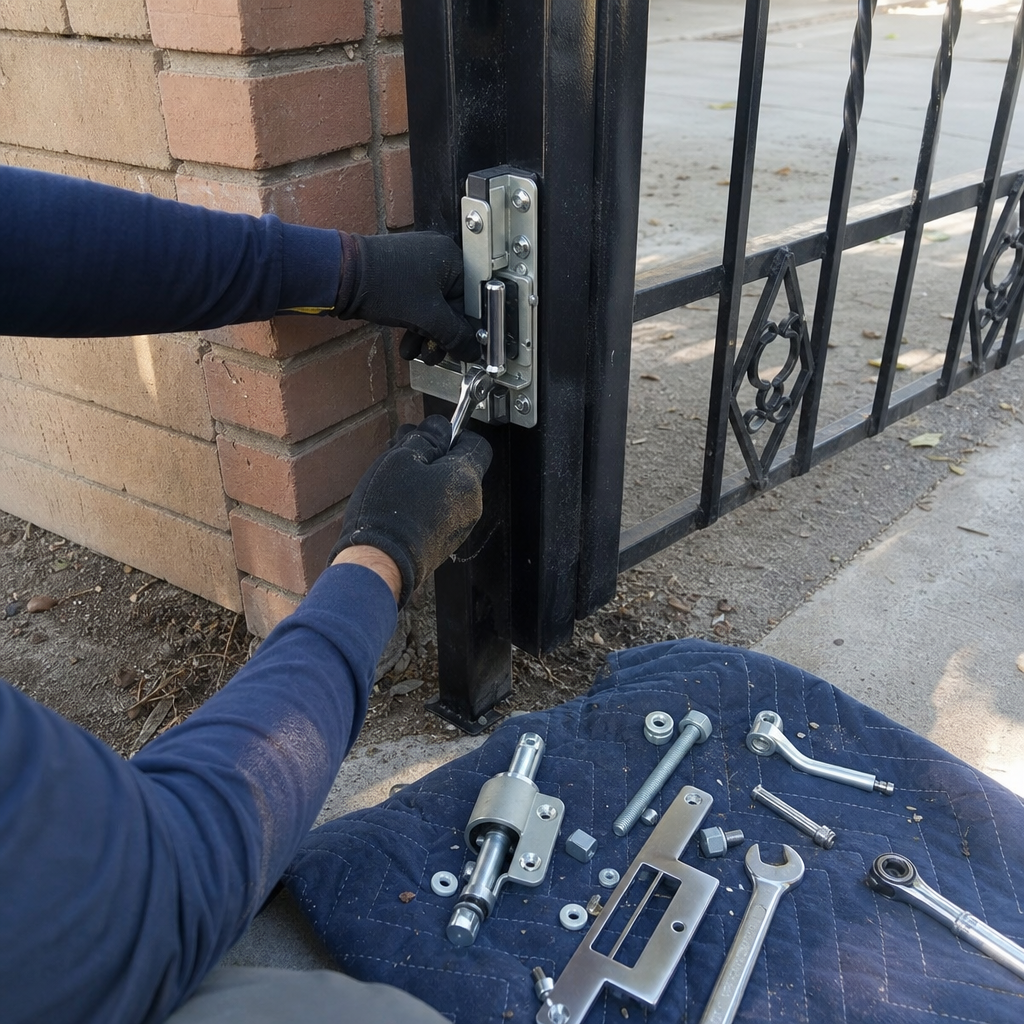
- Hardware tightening: Walk the entire gate and hand-tighten every visible bolt, then snug with a wrench. Hardware that vibrated loose over winter wind events is easy to miss because it may look fine from a distance.
- Rust inspection: Check any bare metal edges on the gate frame for rust initiation. Surface rust addressed in April with a rust-converting primer and touch-up paint is a 20-minute fix. The same rust spot ignored until August can become a structural concern on a tube-steel gate frame.
- Remote and keypad battery check: Replace remote batteries every spring regardless of whether they seem low. A remote that’s marginal in March will definitely fail in July heat when the electronics are working harder.
- Safety sensor alignment: Clean photo-eye sensors and verify alignment. Glendora’s winter winds deposit a surprising amount of fine debris on sensor lenses. A sensor that’s 20% blocked reads fine in low-light spring mornings but can trigger false obstructions in harsh summer afternoon backlight.
- Operator behavior log: Run five full open-close cycles and note anything that seems different — hesitation, unusual sound, a position the gate pauses at. These subtle changes are early diagnostic signals that a technician can act on before they become failures.
The One Annual Professional Service That Prevents the Most Expensive Failure
If there’s a single thing Glendora homeowners consistently skip that leads to the most expensive repairs we handle, it’s surge protection service on automatic gate operators.
Glendora sits in an area that experiences meaningful power-quality events during Santa Ana season — not just outages, but voltage spikes when power is restored after a line trip. Those restoration spikes are the primary cause of logic board failures in automatic gate operators. A replacement control board for a mid-range operator typically runs $300–$600 in parts alone, plus labor. The surge protection hardware that would have prevented it costs a fraction of that.
Here’s what a proper annual electrical and surge protection service includes:
- Surge suppressor inspection: If your operator has an integrated or add-on surge suppressor, confirm it hasn’t sacrificed itself protecting against a prior event. A suppressor that’s absorbed a spike is depleted — it won’t protect against the next one. Most homeowners don’t know these need to be checked or replaced periodically.
- Battery backup load test: The battery in your operator’s backup system should be load-tested, not just voltage-checked. A battery can show 12V at rest and still fail under the actual current draw of the operator motor.
- Terminal connection inspection: Power and signal terminals on operator control boards corrode gradually. An annual cleaning and retorquing of all terminal connections prevents the intermittent faults that cause misdiagnosed “board failures” — faults that are actually just a loose or oxidized terminal.
- Ground wire continuity check: Improper grounding is a force-multiplier for surge damage. A technician should verify that the operator is properly grounded to a tested earth ground, not just bonded to a nearby metallic structure.
- Full diagnostic scan: Operators that support onboard diagnostics (most BFT, FAAC, and LiftMaster units manufactured in the last decade do) should have their fault logs read and cleared annually so you’re working with current operational data.
Schedule this service in September — before Santa Ana season — and you’ve protected the most expensive single component in your gate system for the highest-risk window of the year. This is the one annual appointment we recommend to every gate owner in Glendora without exception. Learn more about what’s involved with a full motor and operator assessment on our Gate Motor & Opener in Glendora service page.
Common Mistakes to Avoid
- Lubricating with WD-40 as a maintenance product. WD-40 is a water displacer and penetrating oil, not a long-term lubricant. Used on gate hinges and pivot points in Glendora’s dusty dry months, it attracts particulate contamination and leaves joints drier than they started within a few weeks. Use a dedicated dry PTFE spray or a white lithium grease appropriate for metal-to-metal contact.
- Running a thermally tripped operator to “see if it’s really stopped.” Repeatedly cycling an operator that’s in thermal protection mode generates more heat, which extends the recovery time and in some cases can push internal temps high enough to cause actual damage. If it’s stopped on a hot day, give it time before you start troubleshooting.
- Ignoring a latch that “still kind of works.” A striker or latch that requires force to engage is already misaligned. In Glendora’s hillside neighborhoods where post movement is a real factor, this is an early warning sign of shifting — not a hardware quirk to live with. Let it go and the operator starts compensating, which strains the drive mechanism.
- Waiting until a gate fails completely to schedule service. Gate operators don’t typically fail without warning — they warn slowly through small behavioral changes that are easy to dismiss. Scheduling a check when something seems slightly off almost always results in a cheaper repair than waiting until the gate won’t open at all.
- Assuming a gate that “moves fine” is fine. A gate that opens and closes without drama can still have a post that’s two degrees off plumb, a drive arm that’s developing stress at a weld, or a surge suppressor that’s already depleted. The gate working is not the same as the gate being in good condition.
- Using the wrong lubricant inside the operator housing. Some homeowners open the operator cabinet and spray lubricant on the internal gears. Operators that use a grease-packed gearbox — which is most of them — don’t need this, and introducing the wrong lubricant can break down the factory grease, wash it out of the gear mesh, and cause premature wear. Leave the internal gearing to a technician.
- Skipping the pre-Santa Ana check because “last year was fine.” Wind events are cumulative in their effect on gate hardware. A hinge bolt that held through five Santa Ana seasons may be one season away from failing — but you won’t know unless you check. The pre-season inspection is cheap. The post-wind repair usually isn’t.
When to Call a Professional
Some gate issues are genuinely user-serviceable — a remote battery swap, a sensor lens cleaning, a PTFE lube pass on the hinges. Others are situations where calling a technician is the right move from the start.
Call a professional when: your gate post is visibly off-plumb or the concrete pad around it is cracked and lifting; the operator runs but the gate doesn’t move, or moves only partially; you hear grinding or clicking sounds from inside the operator housing; the gate won’t hold its closed position under any wind pressure; a safety sensor is consistently triggering faults you can’t clear by cleaning the lens; or any structural weld on the gate frame shows visible cracking. High-tension gate components — springs, counterbalance systems on heavy swing gates — should never be adjusted or removed without proper training. The stored energy in these systems can cause serious injury if released incorrectly.
For Gate Repair in Glendora, Apex Gate Repair Services offers free estimates — call (562) 378-6866 and Jonathan Wright will assess the situation directly. You’re talking to the technician, not a scheduler.
Frequently Asked Questions
Once per year is the right baseline for most Glendora residential gates, with that appointment ideally scheduled in September before Santa Ana wind season begins. Properties on hillside or sloped driveways where post movement is a risk may benefit from a secondary check in March, after the winter rain window closes. Annual service on the operator’s electrical components — surge protection, battery load test, terminal inspection — is the single most cost-effective gate maintenance decision a Glendora homeowner can make.
That’s almost certainly a thermal protection trip, not a mechanical failure. When ambient temperatures in Glendora push above 95°F, the motor inside your gate operator generates heat faster than it can dissipate it. Once internal temperature crosses the protection threshold, the unit shuts down to prevent motor damage — and it restarts once it cools, usually within one to three hours. If your gate consistently recovers on its own after cooling and shows no other symptoms, it’s working as designed. If it doesn’t recover after cooling, or you hear unusual sounds, that’s when a service call is warranted.
Start with the latch: a gate that previously engaged its striker cleanly but now requires a nudge or doesn’t fully latch has shifted, even if the movement isn’t visible. Put a 4-foot level against the post face and check for plumb — more than 2–3 degrees of lean is significant. Check the soil immediately around the post base for cracks or gaps between the post collar and the surrounding ground. If you find any of these signs, stop running the gate on its automatic cycle and call for an inspection. Driving a shifted gate repeatedly accelerates wear on the operator drive system.
Control board replacement on an automatic operator is typically the highest-cost single-component repair, running $300–$600 in parts alone before labor. The primary cause in Glendora is power surge damage from voltage spikes during and after utility outages — which peak during Santa Ana wind events when lines trip and restore repeatedly. Annual inspection and replacement of your operator’s surge suppressor, combined with proper grounding, prevents the overwhelming majority of board failures. A depleted surge suppressor looks functional but offers no protection — most homeowners don’t know to check it.
The answer depends on what’s failed, not how old the unit is. A ten-year-old operator with a failed limit switch or a depleted battery backup is worth repairing — those are consumable components, not signs of systemic failure. An operator where the control board has failed, the motor windings show deterioration, and the gearbox is worn is approaching end-of-life, and the repair cost should be weighed against a new installation. In our experience, operators from quality manufacturers — including Linear and Viking units — routinely reach 15–20 years with proper maintenance. The service history tells you more than the age does. For replacement options, our Gate Installation in Glendora page covers what a new system involves.
The visual inspection and hardware tightening described in this guide are genuinely homeowner-serviceable tasks — walking the gate, checking for visible cracks or loose bolts, cleaning sensors. What’s beyond DIY scope: limit switch adjustment, arm connection replacement, structural weld inspection, and any assessment of whether post movement is occurring. If your pre-season walkthrough turns up anything beyond surface-level concerns, book a technician before October. The cost of a pre-season service call is predictably lower than a post-Santa Ana emergency repair — and Jonathan Wright can tell you on the spot what condition your system is actually in.
The Bottom Line
Glendora’s gate maintenance calendar has three pressure points: Santa Ana wind season in the fall, the winter rain window and its soil-movement aftermath, and summer heat accumulation through July, August, and September. Generic gate care guides miss all three. The most effective Glendora-specific maintenance plan is built around a September professional service appointment, a post-rain self-inspection in February, a spring hardware check in March or April, and the discipline to call a technician when something behavioral changes — before the gate stops entirely. Consistent maintenance on this schedule prevents the two most expensive repair categories in this market: control board replacement from surge events, and post-reset work from unaddressed soil movement. The gate that gets checked annually is almost never the gate that fails at midnight.
To schedule a free estimate with Jonathan Wright directly — not a call center, not a dispatcher — call (562) 378-6866. Apex Gate Repair Services has been working gates in Glendora since 2003, and 514 customers have rated that work 4.9 out of 5 stars. That record exists because the diagnostics are right the first time and the repairs are built to hold through the next Santa Ana season.
Written by Jonathan Wright, Owner & Lead Technician at Apex Gate Repair Services Glendora, serving Glendora since 2003.